

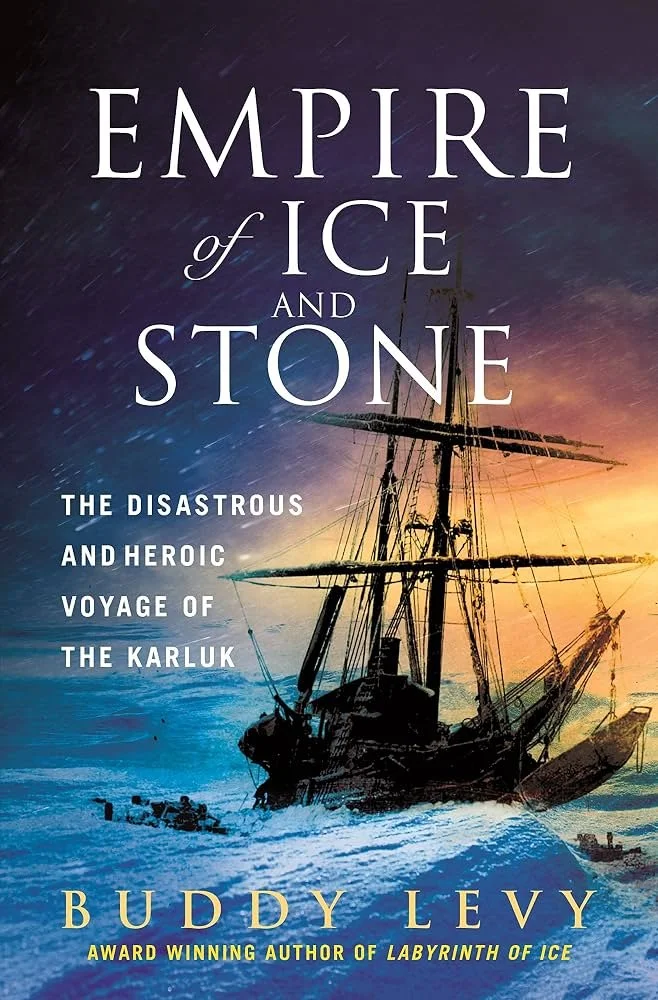
The credit for this discovery goes to Audible’s algorithm, which crunched the numbers on my listening habits and concluded that I might enjoy being stranded in the Arctic at the dawn of the 20th century, surviving on fetid scraps of seal meat and watching my number of viable toes dwindle one-by-one as the weeks pass. An excellent call, as it turns out. Buddy Levy’s Empire of Ice and Stone, narrated by the tour-de-force that is Will Damron, recounts the disastrous 1913 voyage of the Karluk, whose passengers and crew found themselves with ample opportunity to reconsider their enthusiasm for polar exploration as their scientific research cruise devolves into a deadly bid for survival on the merciless shores of the Arctic Circle. It’s a terrific find: a story of courage, vanity and appalling hardship that raises uncomfortable questions about whom we trust to lead us—and what happens when that trust is misplaced.
Its organiser, Vilhjalmur Stefansson, was a Canadian-born explorer and ethnologist with considerable Arctic experience and a ravenous appetite for headlines. On Robert Peary’s recommendation, he contacted Captain Robert “Bob” Bartlett by telegram at his home in Brigus, Newfoundland. While Bartlett had commanded ships on Peary’s polar expeditions, much of the company assembled around him lacked comparable experience. Scientists and sailors travelled alongside Inuit hunters, a seamstress, her two young daughters, a pack of sled dogs and a small black cat that was smuggled on board at the last minute. Backed by the Canadian government, the expedition aimed to locate and claim new territory, study Indigenous cultures, collect animal and plant specimens, and investigate the Arctic Ocean.
The scientific programme was substantial, although national prestige and personal ambition complicated any notion that the trip’s goals were purely academic. With the Karluk’s survivors returning to a world newly at war, the story feels like a bookend to the great age of polar exploration. Crew accounts and subsequent histories have covered it extensively, but I had never heard of it. Assuming I’m not alone, I’ll avoid major spoilers.
The ship itself inspired little confidence when it enters the annals of history. An ageing wooden whaler, it prompted serious doubts from Bartlett about its ability to withstand the brutal conditions ahead. Trapped in pack ice and carried west, it becomes the setting for deteriorating relationships as well as deteriorating prospects. Stefansson’s departure on an ostensibly temporary hunting trip leaves Bartlett entirely responsible for those aboard.
When the ice crushes the hull, the company must camp on the frozen sea before finally attempting to reach Wrangel Island. Levy follows their increasingly desperate circumstances alongside Bartlett’s soul-whipping, ambulatory journey with the Iñupiaq hunter Kataktovik: roughly 700 miles across sea ice and along the Siberian coast to seek help. The surviving journals and photographs render these wild and extreme feats impossible to dismiss, even when they all but defy reasoned credibility.
Life in the camps is alternately admirable and infuriating. Resourcefulness and generosity coexist with behaviour that makes an already desperate situation worse. The eventual rescue brings enormous relief, while Levy’s attention to the aftermath gives the account a satisfying completeness.
I particularly appreciate his willingness to take sides. The divide between Stefansson and Bartlett gives the book its central argument, and Levy is explicit about where his sympathies lie. He doesn’t merely arrange the evidence and trust us to detect his disapproval. He explains why he considers particular decisions reckless or self-serving, then delivers his verdict. His case against Stefansson is forceful, the sheer scale of evidence tipping seismically in Bartlett’s favour.
Will Damron’s narration is equally assured. One of my favourite narrators, he gives the characters distinct personalities without turning them into performances that distract from the writing. His delivery is warm, conversational and easy to settle into, with neither the dryness of a lecture nor the insistence of an actor determined to make every sentence dramatic. Alongside Derek Perkins and Scott Brick, his name on an audiobook moves it straight up my list.
At fourteen hours and forty minutes, the length feels right: enough time to become absorbed in the expedition without committing several weeks to it. I finished in just over a week, actively looking forward to lunchtime and evening walks for another instalment.
A superb listen that makes its historical argument as compelling as the struggle to survive.