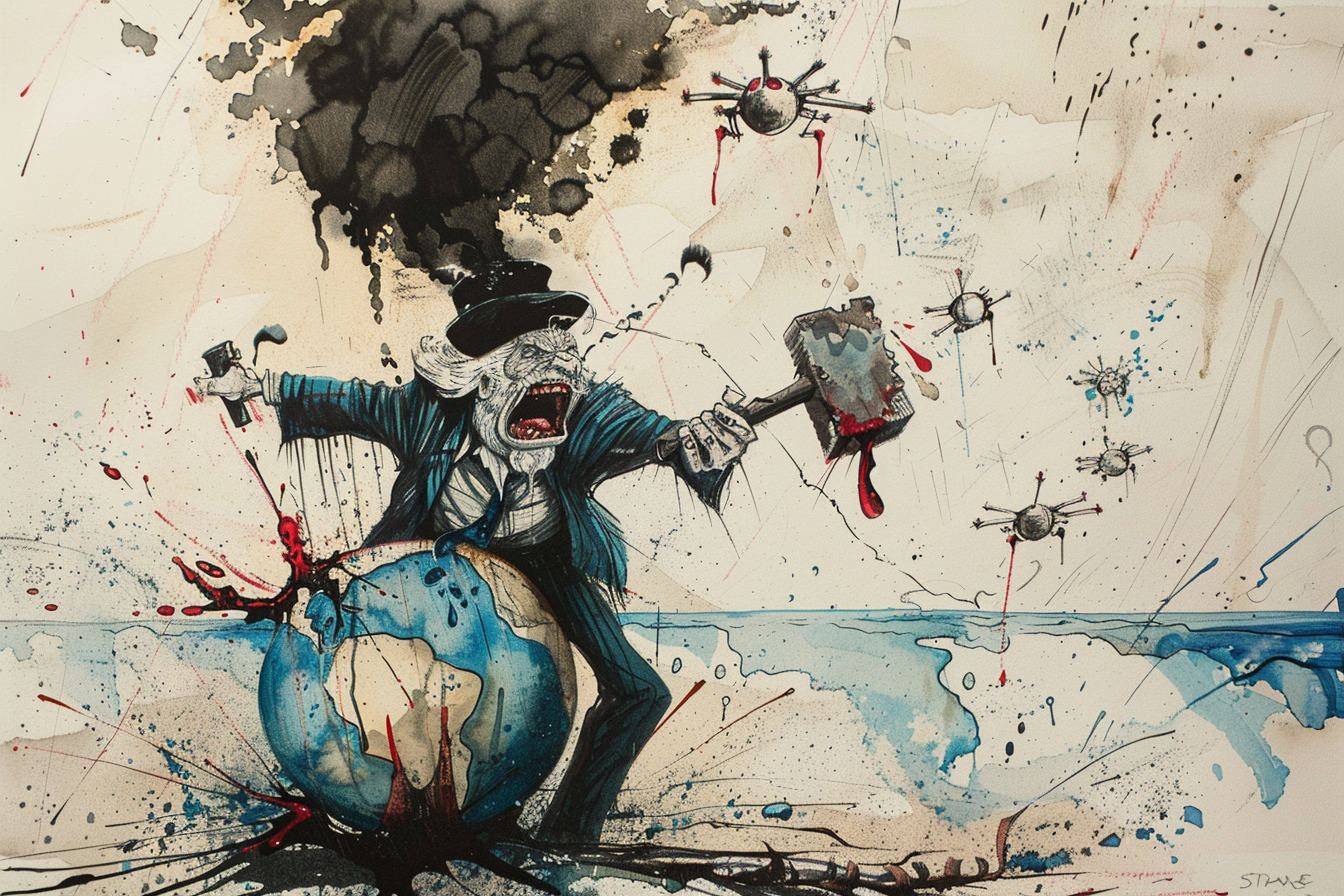
Image credit: Joe Daly 2026
At 4:12 a.m., the iPad detonated on my nightstand.
Not a buzz. Not a polite vibration. A digital air raid siren. I cracked open Apple News and peered through sleepy eyes.
“Annihilate their navy.”
“Raze their missile industry to the ground.”
“Lay down your arms or face certain death.”
It read less like a presidential statement and more like Dave Mustaine’s lyrical castoffs left in the Oval Office by mistake.
By the time the coffee hit my bloodstream, the United States and Israel had launched coordinated strikes across Iran. According to David Ignatius in The Washington Post (Feb. 28, 2026), President Trump declared that Supreme Leader Ali Khamenei had been killed in the opening barrage. Iranian drones struck near the U.S. Fifth Fleet in Bahrain. Missiles arced toward Gulf states. The Strait of Hormuz — that thin, arterial choke point through which roughly 20% of the world’s oil flows — was reportedly closed.
Twenty percent.
That’s not a regional flare-up. That’s the global bloodstream.
Oil futures began twitching before dawn like a relapse chart. Cable news anchors spoke in the antiseptic dialect of “precision strikes” while the crawl at the bottom of the screen suggested we may have just kicked a hornet’s nest the size of the Persian Empire. More eyeballs on the pickup truck commercials.
Eerily, the phrase of the morning was “one and done.”
Jesus Christ on a hammock.
We are a nation addicted to decisive action. We love it the way gym bros love creatine. The way investors love a clean breakout chart. The way a man in a crumbling relationship loves the idea of one final ultimatum that will fix everything at once.
Force feels clarifying. It feels adult. It feels like control.
The hawkish case, laid out in The Wall Street Journal by Seth Cropsey (Feb. 28, 2026), is not cartoon villainy. It’s strategic muscle. Iran, he argues, is a key partner of Russia and China. Degrading its missile infrastructure, command networks and nuclear capacity is not about theatrics; it’s about deterrence. Iran’s air defenses were already weakened by prior Israeli strikes. Its ballistic missile production has been estimated at roughly 100 per month by Israeli sources cited in the Journal. Hit now. Hit hard. Signal to Moscow and Beijing that American power projection is not theoretical.
This is the language of chess players, not cowboys.
But geopolitical systems don’t die like action-movie villains.
Ignatius warns that regime-change wars rarely end as quickly as their opening salvos. Iran is not a man. It is the Islamic Revolutionary Guard Corps. The Basij militia. An intelligence apparatus. A sanction-hardened economy. A political theology that reveres martyrdom.
Kill a leader inside a martyrdom culture and you don’t necessarily remove a head. You may canonize a saint.
Meanwhile, the international reaction complicates the narrative of American isolation. Canada publicly backed U.S. action “to prevent Iran from obtaining a nuclear weapon,” according to reporting carried by Fox News (Feb. 28, 2026). Australia echoed support. The United Kingdom emphasized that Iran must never develop nuclear weapons. Emmanuel Macron warned of escalation but did not condemn Washington outright. Saudi Arabia condemned Iranian missile strikes on Gulf states rather than U.S. action. China called for de-escalation. Russia criticized but did not mobilize.
This is not Iraq 2003. This is a coalition holding its breath.
And that’s where the vertigo sets in. Because here’s the uncomfortable truth: both sides have a point.
Deterrence sometimes requires teeth. Regime-change wars often metastasize.
We are suspended between those two realities.
And the most unsettling thing isn’t that someone is obviously wrong.
It’s that everyone sounds so goddamned sure.