The Metal Hammer Critics’ Poll 2025: The Year Metal Stopped Being A Genre And Became a State of Mind
I grew up in the 1970s, when rock still felt dangerous, mainly because adults said it was. I got properly switched on in the 1980s, when heavy metal arrived with volume, velocity, and the implicit promise that if you played this loud enough, nothing else could touch you. I survived the 1990s — the purges, the sneers, the sudden reclassification of entire genres as “embarrassing” — and I welcomed the new millennium, when metal didn’t just splinter, it atomised. Subgenres breeding subgenres, scenes within scenes, niches so specific they could barely support a decent tour. To me, that fragmentation felt healthy. Metal stopped pretending it was one thing and started acting like an ecosystem.
But somewhere along the way, something else flourished too: the metal gatekeeper.
Not a fan. Not a critic. A sentry. A self-important boor. A person whose entire sense of self became so tightly wound around a personal definition of “real metal” that any deviation wasn’t just wrong — it was an existential threat. If your metal didn’t sound like their metal, then by some warped emotional logic, you were erasing them. This wasn’t about taste anymore. It was about survival.
Which is why the Metal Hammer Critics’ Poll for 2025 doesn’t just read like an end-of-year list to me — it reads like a verdict. After decades of checkpoints, purity tests, and imaginary borders, here’s a panel of lifers, obsessives, and professional listeners effectively tearing up the passport and saying: this is what metal looks like now. Not a single sound, not a single uniform, not even a single agreed-upon definition — but a constellation of records bound by conviction, atmosphere, and the willingness to commit fully to a vision. The poll doesn’t argue with the gatekeeper. It simply walks past him, clipboard in hand, and starts counting something else entirely: impact, identity, and the feeling that these records mattered in a year where meaning is in increasingly short supply.
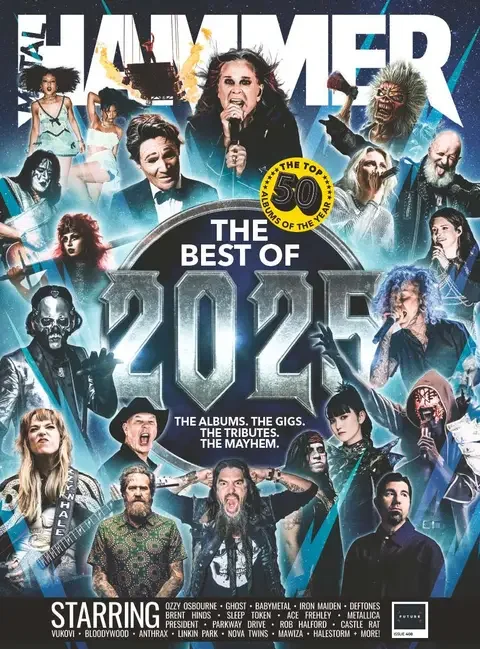
As someone who has had the privilege of voting in this poll for the past 15 years, I am delighted with this year’s results. Because if you look at this list with old-world eyes, it’s chaos. It’s heresy. It’s a pub argument that escalates into someone getting glassed. Ghost at No.1, Deftones at No.2, Castle Rat at No.3, Spiritbox at No.4, Messa at No.5, Deafheaven at No.6, Turnstile in the top 10, Wardruna rounding it out like a pagan ceremony happening just outside the festival gates. This list is pure anarchy and I’m here for it. But dig deeply and you see how coherent it all is. It has a shape. It’s telling you exactly what metal criticism is becoming — and what it quietly stopped being.
If you want the simplest thesis: this list treats metal not as a musical style, but as a psychological condition. Metal, in 2025, is what happens when music commits fully to its own internal universe — aesthetically, emotionally, conceptually. Heavy is no longer a decibel reading. Heavy is a worldview. Ghost’s Skeletá taking the crown is the loudest evidence. They’re not the heaviest band on the list. Not even close. But they are an arena-sized myth machine. They do what metal has always done best — build a cathedral out of spectacle and conviction — and they do it with a grin so wide you can see the fangs.
Deftones at No.2 is the other half of the new axis: heaviness as sensuality, dread, and atmosphere. Their form of weight isn’t blunt force; it’s pressure. It’s the feeling of a room getting smaller while you’re still trying to act normal. Now slam Castle Rat into No.3 and you can see the critics’ appetite: world-building, character, commitment. That record doesn’t just play doom — it inhabits doom. It arrives in costume and refuses to take the mask off even after last orders.
Spiritbox at No.4 is modern metal’s cleanest example of the new prestige pathway: huge production, emotional clarity, hooks that land like haymakers and the sense that the band understands the internet without being swallowed by it. Messa at No.5 is the curveball with the blade hidden in it: doom as late-night jazz club haunted by a restless spirit.
That’s the top five telling you that Metal Hammer’s critics aren’t rewarding sonic purity. They’re rewarding identity. This list isn’t “what was the best metal album?” It’s “what albums felt the most real inside their chosen fantasy?” And that’s how you get a scene that can put Wardruna in the top 10 without blinking.
There’s a specific kind of metalhead who’s going to read this list like a man discovering his house has been repossessed. Turnstile at No.8. AFI at No.16. Propagandhi at No.32. Backxwash at No.28. You can practically hear the old guard coughing into their pints. But here’s the thing: this isn’t critics “letting non-metal in”. It’s critics admitting what’s been true for a while: metal has become a cultural umbrella, not a closed shop.
Not everything in the tent sounds like Slayer. The tent has expanded because the world expanded — and because the last decade taught everyone, painfully, that genre police are rarely defending art. They’re usually defending identity. So critics found a new job title: curator instead of gatekeeper. The question is no longer “does it qualify?” The question is “does it hit?”
And “hit”, in 2025, means: does it have conviction? Does it take risks? Does it build an atmosphere you can live inside? Does it feel like it matters — even when it’s absurd. These are the criteria I apply to every album that I review. This is why an album can be adjacent-to-metal and still land higher than a veteran thrash band playing by the rules. The rules are not the point anymore. The point is the effect.
If there’s one corner of this list where I feel less like an observer and more like a co-conspirator, it’s the extreme end. Black metal has been one of my deepest, longest-running fixations — not as a nostalgia exercise or a purity contest, but as a living, mutating language. I’ve reviewed more black metal records for Metal Hammer than I can reasonably count, and when I put together my own top ten this year, it leaned hard into that darkness: Blackbraid, Havukruunu, Abigail Williams, 1914, and Lucifer’s Child all featured prominently. Not all of them made Metal Hammer’s final top 50 — that’s the nature of consensus — but seeing so many blackened crews land high in the critics’ poll felt quietly affirming. Not because “my taste won,” but because it confirmed something I’ve felt for years: extreme metal isn’t lurking at the margins anymore. It’s central to how critics understand what metal is, provided it’s saying something beyond lineage worship and corpse-painted pageantry.
Behold Blackbraid at No.20, Havukruunu at No.21, Gaahls Wyrd at No.33, Der Weg Einer Freiheit at No.40, Imperial Triumphant at No.13, Agriculture at No.27, Deafheaven at No.6.
That’s a lot of darkness. But notice the flavour: it’s expressive, conceptual, and often culturally specific. Blackbraid III isn’t on the list because it’s “trve”. It’s on the list because it’s a voice. It has identity. It has perspective. It feels like it comes from somewhere more interesting than a rehearsal room and a stack of Bathory records. Havukruunu are mythic black metal, the kind that makes you feel like history is still alive and hungry. Der Weg Einer Freiheit are existential collapse with blastbeats, a band that treats emotion like a weapon. Imperial Triumphant are avant-garde excess — jazz-club apocalypse, the soundtrack to a city eating itself. Even the so-called “post” entries — Deafheaven, Agriculture — aren’t here as genre experiments for their own sake. They’re here because they offer transcendence: the black metal stylings repurposed as catharsis rather than cruelty.
Another big pattern: a shocking percentage of this list feels like it was written for the modern condition — overstimulated, burnt out, doomscrolling, half-lonely, half-numb — and the albums that rise are the ones that offer immersion. Wardruna. Hexvessel. Jonathan Hultén. Messa. Cwfen. Gaahls Wyrd. Even elements of Spiritbox and Deftones. These are records that don’t just deliver songs; they deliver environments. It’s metal criticism rewarding albums you can live inside rather than albums you merely consume.
In the streaming era, that’s a fascinating reversal. The world trained us to skip. My colleagues are rewarding records that demand you stay. And yes, there’s irony here: metal — once the music of bars, sweaty rooms, and communal catharsis — has also become music for solitude. Headphones metal. Candlelit metal. “I need to feel something real” metal. That’s not dilution; that’s adaptation.
This list is also quietly brutal to the old hierarchy. The veterans show up — Paradise Lost, Coroner, Machine Head, Testament, Katatonia, Lacuna Coil — but most are clustered in the teens and the bottom half. It’s not disrespect, it’s recalibration. The critics are saying: we love you. We’ll salute you. But you are not the centre of the conversation by default. The centre belongs to the bands who feel like they’re changing the air pressure. Or at least the bands who feel like they’re conjuring something exotic rather than maintaining a brand.
That’s why Ghost can win: they feel like an event. That’s why Spiritbox is top five: they feel like the future. That’s why Castle Rat can outpace a household-name legacy act: because novelty plus conviction beats reputation plus competence. And if you’re a veteran reading this, the message is simple: you don’t get to coast. You have to mean it again.
One of the strangest undercurrents here is the label spread. You’ve got major infrastructure (Roadrunner, Century Media, Nuclear Blast, RCA, Reprise) sitting right next to indies and self-releases that are not merely tolerated but celebrated. Blackbraid self-released at No.20. Paleface Swiss and Beyond Extinction self-released lower down. Castle Rat on Blues Funeral in the top three. The Flenser represented. Svart. Prophecy. Season of Mist. Critics are signalling that the old system — big label equals big prestige — isn’t automatically true anymore. Access to an audience has decentralised. Distinctness travels faster than budgets.
But there’s another angle: the big labels are still the machinery of scale. When a band becomes an event, they tend to be attached to infrastructure that can carry the weight. The list isn’t anti-industry; it’s post-industry. It reflects a culture where both paths are viable: the major-label megaphone for large-scale “moment” bands, as well as the indie/self-release route for artists with a sharp vision and a niche that behaves like a religion.
Here’s the most “offbeat” trend of all: this list rewards bands that tell stories, not necessarily lyrically, but aesthetically. Ghost is theatre. Castle Rat is roleplay. Wardruna is ritual. Imperial Triumphant is satire-horror. Messa is noir doom. Creeper is gothic melodrama. Lorna Shore is operatic extremity. Bloodywood is cultural fusion with a message. Blackbraid is identity-driven myth. Even the more “bandy” bands here have a strong sense of narrative framing. This is metal in the era where attention is fleeting and algorithms are merciless. Story becomes survival — not as gimmick, but as a way to create meaning that cuts through the noise. The days when you could just be “a good riff band” and expect the culture to notice you are fading. The critics are, perhaps unconsciously, voting for memorable identity. And that’s a tough pill for old-school purists because it suggests the new core skill isn’t just songwriting — it’s mythmaking.
If you want to boil down what this poll “tells us” in one bruising sentence: We — Metal Hammer’s critics — are voting for a metal culture that doesn’t need the word metal to justify itself. We’re selecting albums that work as art, as atmosphere, as statements, as worlds — and then allowing metal to be the gravitational field that holds them all together. That’s why you get genre trespassers on the list. That’s why you get folk ritualism next to deathcore. That’s why you get avant-garde jazz-metal nonsense sitting near classic doom. The list argues that metal is no longer a sonic box. It’s a language of intensity. And intensity has many dialects.
If this poll functions as a compass, then it isn’t pointing back toward any imagined golden age or forward to some neatly branded future. It’s pointing outward. Toward a version of metal that values immersion over obedience, atmosphere over rulebooks, and sincerity over subgenre conformity. The records that rise here are the ones that build worlds rather than merely reference old ones, that trust mood and meaning more than lineage, and that understand extremity as something emotional and conceptual, not just sonic. Legacy still counts, but it no longer confers immunity; reputation isn’t a shortcut when conviction is the real currency. At the same time, the presence of indie and self-released albums isn’t tokenistic — it’s proof that vision now travels faster than infrastructure. What this poll ultimately suggests is that metal criticism has stopped asking whether something qualifies and started asking whether it matters. That shift will infuriate the genre accountants and thrill anyone who understands metal as a living, mutating organism rather than a museum exhibit. And the biggest irony of all is this: metal hasn’t softened in the process. It’s expanded — wider in scope, deeper in feeling — learning to speak in multiple tongues without ever dulling its teeth.