

Southern rock has spent half a century trapped inside its own mythology. The rebel flags. The whiskey. The hellraising outlaws, hard-living women and endless variations on Tuesday being gone. At its best, the genre gave us At Fillmore East, Second Helping and The Southern Harmony And Musical Companion—records with blood in their grooves and thunder under the hood. At its worst, it mistook history for identity and embalmed an entire region in bourbon, bravado and enough distressed denim to upholster a NASCAR grandstand.
Then Jason Isbell wrote “Decoration Day.”
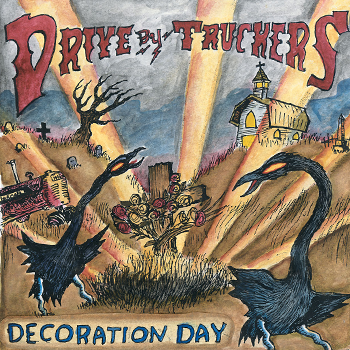
Released as the title track of Drive-By Truckers’ 2003 album, it arrived as Southern rock had begun to fossilise into a heritage exhibition: a rebel yell trapped beneath glass. Isbell didn’t polish the mythology or drag it out for another victory lap. He cut it open. What spilled out was a six-minute blood feud that recalls Cormac McCarthy at his bleakest, where family pride curdles into tribal insanity and the sins of the father turn up armed.
That is why “Decoration Day” is the greatest Southern rock song of the 21st century. It doesn’t merely sound like the South; it shows where the bodies are buried.
Isbell was 22 when he joined Drive-By Truckers on the road behind 2001’s Southern Rock Opera, walking into a band already powered by two lethal songwriters in Patterson Hood and Mike Cooley. Within his first few weeks in the band, he had written “Decoration Day.” Most new recruits spend their first week learning where to stand. Isbell turned up with the album’s title track and, in “Outfit,” another song that would become a cornerstone of the band’s catalogue.
“Decoration Day” drops us into a war between the Hills and the Lawsons, two families locked in a cycle of vengeance so old that nobody can remember what lit the fuse. Isbell reportedly based it on a genuine feud involving members of his extended family, but the song reaches far beyond family folklore. It feels true in the way the darkest stories do: not because every detail can be proved, but because every wound can.
The narrator is a Lawson, conscripted at birth into a war he cannot escape. To his father, violence is duty, inheritance and proof of blood. When the old man orders him to brutalise a Hill boy, the son admits that the Lawsons have brought the trouble upon themselves, and for that one flickering moment, he sees the feud for what it is. Then comes the chain on his back, his ear to the floor and a vow to send the Hill boys to hell. Whether the chain is real or metaphorical barely matters – the feud has done its work, turning a son who questioned the violence into a man promising more of it.
The brilliance lies in Isbell’s refusal to make the narrator either hero or victim. He despises his father, grieves for him, fears him and remains bound to him. He knows the Lawsons have brought much of their suffering upon themselves, yet he still feels the ancestral pull of revenge. By the end, he can even understand why the Hills wanted his father dead. That flash of empathy is the song’s moral detonation.
A lesser writer would have sent the son riding off toward redemption, the family curse broken behind him, but Isbell grants him no such escape. The song tells us that he has family in Mobile Bay who have never seen his father’s unmarked grave; it does not tell us whether he lives among them or has broken free of the feud. What it does reveal is that, on Decoration Day, he remains locked in an argument with a dead man—imagining his father’s voice, contemplating spitting on his grave, then repeating the very vow of vengeance his father taught him. The old man is dead. His voice isn’t, and as William Faulkner wrote in Requiem for a Nun, “The past is never dead. It’s not even past.”
This is Southern storytelling stripped to its blackest elements. “Decoration Day” has the bones of a murder ballad, but Isbell refuses to give us one clean crime, one righteous victim or one villain whose death might restore order. The song offers a young man beaten nearly senseless, a father shot dead, brothers buried in Lauderdale South and East Tennessee, and a feud whose origins have been swallowed by time. Nobody wins. The violence simply changes hands.
This alone elevates “Decoration Day” into the pantheon of great Southern storytelling. What makes it such an evocative Southern rock song is what the band builds around it, beginning with a wall of guitars.
With three guitarists in the room, the Truckers could easily have turned “Decoration Day” into a Southern-rock air show. Instead, they show remarkable discipline. There is no bar-room boogie, no ornamental swagger, no triple-guitar cavalry thundering over the horizon. Drummer Brad Morgan holds the song to a grim, patient pulse while the guitars circle like weather, increasing the pressure as the names of the dead accumulate.
Isbell sings less like a storyteller than a witness giving evidence at gunpoint. His voice is unmistakably young, yet already carries that familiar grain: weary, defiant and somehow older than the man producing it. As the song gathers force, the guitars do not drown out the narrative or offer cathartic escape. They become the feeling the narrator cannot articulate. By the closing coda, the music sounds less like release than possession—as though the feud has finally escaped his body and entered the amplifiers.
That control is crucial. Southern rock has traditionally treated the electric guitar as an instrument of liberation: the open road translated into volume, bent strings and glorious excess (see: “Free Bird,” “Green Grass & High Tides,” “Jessica,” etc.). In “Decoration Day,” the guitar offers no freedom. It bears down. Every chord carries history, rage and the crushing weight of something the narrator understands but still cannot put down.
The 21st century has produced plenty of great Southern songs, several of them written by Isbell himself. None contains a more complete reckoning than “Decoration Day.” Within one family feud, Isbell examines masculine pride, tribal loyalty, historical memory and the corrosion of conscience under inherited conflict. Yet the song never sounds like a songwriter unpacking themes. It sounds like a man discovering, line by line, what his inheritance has done to him.
Most importantly, “Decoration Day” denies Southern rock its most seductive narcotic: nostalgia. Drive-By Truckers had already interrogated the region’s mythology on Southern Rock Opera, an album Patterson Hood described as examining “the duality of the Southern thing.” Where that record wrestled with the South through history, politics and rock mythology, “Decoration Day” dragged the conflict inside the home. Pride and shame were no longer opposing ideas—they were fighting inside one man.
“Decoration Day” showed that Southern rock did not need to abandon its past, only stop romanticising it. Its sense of place comes through choices and consequences rather than symbols. The South is not scenery here, nor a brand to be defended, and the song neither flatters the region nor puts it on trial. It recognises that loyalty can coexist with disgust, love with resentment and family history with moral clarity. That tension is not something Isbell resolves. It is the entire point.
More than two decades later, “Decoration Day” remains the best Southern rock song of the 21st century because it understands that while family history can explain who you are, it cannot excuse what you become.